The Kink Spectrum: A List of Kinks From Vanilla to Everything In Between
 14 min read

Nearly every list of kinks on the internet is a flat inventory. Four hundred entries, one line each, alphabetised, and no sense at all of where you're supposed to be standing while you read it. You scroll. You recognise two things. You feel odd about a third. Then you close the tab, no better informed than when you opened it.
That's the thing this list of kinks is built to fix. Kink isn't a box you're either inside or outside of, and I'd argue the binary framing does more harm than any single item on the list below. Interest, practice, and identity are three separate dials, and they move independently.
Everything below is educational. It's written for consenting adults over 18, and it isn't medical, legal, or therapeutic advice. If something here raises a question about your health or your relationship that a glossary can't answer, a qualified sex therapist or a doctor is the right person to ask.
What "vanilla" actually means
The word came out of the kink community itself in the 1970s, borrowed from the plainest flavour on the ice cream menu, and it was in the Oxford English Dictionary in its sexual sense by 1997. It describes sex that stays inside conventional norms. No BDSM, no fetish object, no negotiated power dynamic.
Here's where most writing on this topic goes wrong. "Vanilla" gets used as a soft insult, a synonym for boring, a diagnosis of someone who hasn't figured themselves out yet. That reading isn't supported anywhere serious. Wikipedia's overview of conventional sex puts it plainly: vanilla-identifying people occupy a legitimate position on what it calls the vanilla-kink spectrum, and someone can be entirely satisfied there.
That matters most in the very common situation where one partner identifies as kinky and the other doesn't. The label "vanilla partner" tends to imply that person is the obstacle. Usually they're just a person with different preferences, which is not the same thing as a problem to be solved.
So if you came here searching what vanilla means in a relationship, that's your answer. It's a position, not a deficit.
So what counts as a kink?
The cleanest kink definition I've found comes from Healthline, which is medically reviewed and quotes four named sex educators rather than anonymous copy. A kink is a sexual preference. A fetish, traditionally, is closer to a requirement, something that needs to be present for arousal. That same piece notes modern educators increasingly dislike the rigid "requirement" framing and prefer to call fetishes erotic superchargers, which is a friendlier and probably more accurate description of how most people experience them.
BDSM is a subset, not a synonym. It covers bondage and discipline, dominance and submission, sadism and masochism. If any of that is new territory, an honest guide to getting started covers the vocabulary and the first steps without assuming prior experience. Kink is the wider category, and it also holds roleplay, sensation play, material fetishes, and power dynamics that have nothing to do with pain.
And then there's the question underneath all the searching: is any of this normal? The clinical answer has shifted a long way. Diagnostic criteria were revised to separate an unusual sexual interest from a disorder, with distress or harm to a non-consenting person as the actual line. Writing in Psychology Today, licensed marriage and family therapist Elyssa Rice summarises the research bluntly: there is "no evidence that BDSM practitioners, in general, suffer from any particular form of psychological disturbance."
That shift was overdue. The same article cites a 2012 study of 766 clinicians in which 25% automatically pathologised kink and 30% believed it should be eliminated through therapy. Which is to say: a quarter of the people you might have gone to for help would have treated the interest itself as the illness.
Five rough stops, not two
I don't think a spectrum is a metaphor here. A 2024 instrument published in the Journal of Sex Research, the Kink Orientation Scale, measures kink across three separate axes: desire, practice, and identity. Those can be wildly out of step with each other. You can want something you'll never do. You can do something occasionally without ever calling yourself kinky. Reasonable to treat the whole thing as a range, then.
The stops below are mine: think of them as a rough kink chart, not a validated scale. They're a reading aid.
Vanilla. Conventional sex, no kink elements, and no particular curiosity about them. A real destination, not a waiting room.
Curious. Fantasy is present, practice mostly isn't. This is a very crowded stop. Kinsey Institute research fellow Justin Lehmiller surveyed 4,175 American adults for his 2018 book Tell Me What You Want and found that nearly every participant had, at some point, fantasised about some form of BDSM. His own takeaway was that people mostly assume their fantasies are abnormal and are relieved to learn otherwise.
Kink-aware. Occasional practice, usually light, usually with a regular partner. Vocabulary starts getting useful around here, because you can't negotiate something you can't name.
Kink-identified. The interest is part of how someone understands themselves sexually, not just something they do sometimes.
Lifestyle and community. Structured dynamics, ongoing power exchange, involvement in local scene or community spaces. The smallest group of the five by some distance.
Worth flagging the numbers behind that shape, because the fantasy-and-practice gap gets flattened constantly. Aggregated prevalence research puts kink-related fantasy somewhere in the 40 to 70% range depending on method, while actual past-year practice comes out far lower, with estimates as low as 1.8% among sexually active Australians in one survey and 6.6% among English festival attendees in another. Those aren't contradictory findings. They're the spectrum, measured.
The list of kinks, arranged by where it sits
This is the part you probably came for: the different types of kinks, organised by intensity and by how much negotiation each cluster tends to need, running roughly from the vanilla end outward. Every entry here is something consenting adults do with each other by agreement, which is a sentence most flat lists never bother writing down.
Sensation play, at the softer end
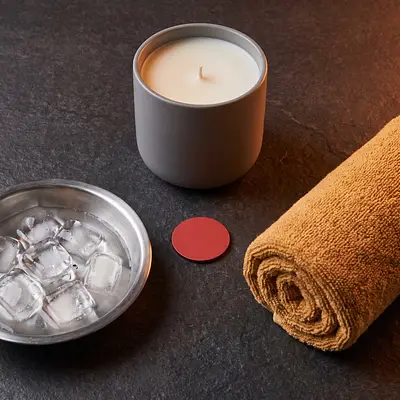
Temperature, texture, light touch, blindfolds, feathers, ice, warm oil. The category is enormous and almost none of it requires equipment or experience.
This is also the point where I'd argue the practical stuff matters more than the exciting stuff. Comfort is what makes a first attempt at anything here go well, and friction is what ends it early. A plain water-based lubricant does more for a beginner sensation session than any gadget, and water-based specifically because it stays compatible with condoms and silicone toys where oil-based formulas don't.
Small power shifts
Not full dominance and submission. Just deciding in advance who's leading, or handing over one specific choice for one evening. Light restraint using a scarf. Being told what to do, in a bounded way, by prior agreement.
The prevalence data here surprises people. A U.S. nationally representative survey of adults aged 18 to 94, published via PMC, found that being sexually dominated appealed to 65% of women and 53% of men, and being tied up appealed to 52% of women and 46% of men. Majority-adjacent interests, in other words, not fringe ones.
Dominance and submission (D/s)
A negotiated power exchange, where one person takes an authority role and the other takes a submissive one, for a scene or for a defined stretch of time. D/s is psychological first. Plenty of D/s involves no pain and no rope at all.
Related terms you'll meet: top and bottom (who's doing and who's receiving in a given scene), switch (someone who does both), brat (a submissive style built around playful resistance).
Bondage and restraint
Rope, cuffs, tape, harnesses, and the whole tradition of shibari and kinbaku. Circulation, nerve compression, and never leaving a restrained person alone are the standing safety concerns, which is why this cluster tends to be where people first go looking for structured instruction rather than a list. Fair warning from experience: rope is the one entry here where I'd send a total beginner to a class before a knot tutorial.
Impact play
Spanking, flogging, paddling, caning. There's a wide intensity range inside this one entry, from playful smacking to heavy impact, and the anatomy of where impact is safe matters more than the implement does. I've watched people agonise over which paddle to buy before they'd learned which parts of the body are actually safe to hit. Backwards order, honestly.
Roleplay and fantasy
Scenario-based play: authority roles, strangers-meeting scripts, pet play, age play between adults, medical roleplay, uniform scenarios. The common thread is a shared fiction that both people have agreed to enter and can exit.
Fetish objects and materials
Latex, leather, lingerie, shoes, feet, uniforms. This is the cluster where the kink-versus-fetish distinction earns its keep, since the item here isn't decoration. It's often the thing carrying most of the charge.
Degradation, humiliation, and verbal play
Consensual name-calling, verbal degradation, praise play as its mirror image. This one deserves a caveat rather than a wink: because the words used are designed to sting, the negotiation beforehand has to be unusually specific about which words are in and which are permanently out.
Sensory deprivation, edge play, and the far end
Hoods, gags, sensory restriction, breath play, needle play, knife play. Some of these carry genuine physical risk, and this is where the responsible thing for a glossary to do is stop describing and start pointing elsewhere. In-person instruction and community mentorship exist for exactly this tier.
Our kink encyclopedia breaks each of these out properly, with intensity ranges, prerequisites, and the safety details attached rather than tacked on at the end.
The part every other list of kinks skips
You can read a list of kinks all day. None of it is worth much without the conversation that comes before any of it, and that conversation has its own vocabulary.
Hard limits and soft limits
A hard limit is absolute. It's a thing a person won't do under any circumstances, often tied to real discomfort or a trigger response, and it doesn't get renegotiated mid-scene. A soft limit is something a person is hesitant about but might consent to with the right conditions, or on a particular day, or with a particular person. Wikipedia's overview of BDSM limits has the fuller definitions.
Naming both, out loud, before anything happens, is baseline practice. Not an awkward exception to it. A written yes/no/maybe list is the tool most couples reach for to do exactly that, turning the hard-limit/soft-limit conversation into something concrete instead of a one-off chat.
Safewords
A pre-agreed word or gesture that communicates consent status clearly, chosen precisely because "no" and "stop" can be part of the fiction in some kinds of play. The traffic-light system is the most widely used version: green for good, yellow for slow down or check in, red for full stop. Gagged or non-verbal? A dropped object or a set number of taps does the same job. If you've never used a safeword with a partner before, how to actually introduce and use one walks through the conversation as well as the mechanics.
Negotiation, check-ins, aftercare
The National Coalition for Sexual Freedom, founded in 1997, has spent decades building consent education for the kink community, including its Consent Counts project, an education outreach programme that trains professionals, and a confidential incident reporting system. Its materials popularised the explicit-and-prior-permission model that a lot of the community now treats as default: agree specifically, in advance, to what's happening.
Which is the detail I find most quietly persuasive about the whole subculture. The consent infrastructure wasn't imposed from outside by educators or regulators. The community built it for itself, because a group of people doing intense things to each other on purpose worked out early that assumption is the failure point.
Aftercare closes the loop afterwards: water, warmth, quiet, checking in the next day. It isn't sentimental garnish. It's the part where two people confirm they're both still fine, including why aftercare isn't only about the submissive partner, since sub drop is real and so is the dominant-side equivalent.
Where do you land?
Probably not where you assumed before you started reading, which is the honest reason I'd rather publish a spectrum than a checklist.
A 2015 study in the Journal of Sexual Medicine surveyed 1,516 adults, 799 women and 717 men, who rated 55 distinct sexual fantasies. Of those, 33 fantasies that met strict statistical criteria for "unusual" turned out to be reported by a majority of respondents anyway. The gap between what feels strange and what's actually rare is enormous, and almost everybody misjudges it in the same direction.
So there's no test at the end of this and no score. You might be curious about two things on this list of kinks and indifferent to the other forty. You might be vanilla and completely content there. Both of those are ordinary results. If something here moved from curiosity to "I'd actually like to try that," planning your first scene is the practical next step: negotiation, prep, and what to expect, in order.
If a term from this list of kinks caught your attention, the SparkChambers kink glossary goes deeper on each one, entry by entry, in the same plain, non-judgemental register. And if the conversation with a partner is the harder part, that's usually the more useful place to start anyway.
Frequently Asked Questions
What is the difference between a kink and a fetish?
A kink is a sexual preference that adds to arousal. A fetish, in the traditional definition, is closer to something that needs to be present for arousal to happen at all. Healthline notes that many current sex educators find that hard line too rigid and prefer describing fetishes as erotic superchargers. In everyday conversation people often reach for "fetish" as a kink synonym, and that's usually fine.
Is BDSM the same thing as kink?
No. BDSM covers bondage and discipline, dominance and submission, sadism and masochism. It's one cluster inside the much larger kink category, which also holds roleplay, sensation play, material fetishes, and power dynamics involving no pain whatsoever. All BDSM is kink. Plenty of kink isn't BDSM.
What does vanilla mean in a relationship?
It describes a partner whose sexual interests stay inside conventional norms: no kink, no fetish, no negotiated power dynamic. Boring isn't the right read either. Plenty of people land here on purpose, by preference, and stay perfectly happy about it.
How do I know if I'm kinky?
There isn't a threshold to cross. Research instruments measure kink across three separate dimensions, desire, practice, and identity, and those move independently. Fantasising about something without ever acting on it is extremely common. Whether you call yourself kinky is a label question, not a factual one, and nobody else gets to award it.
Does having kinky interests mean something is wrong?
Clinicians used to treat kink itself as the problem. That's no longer the mainstream clinical position: diagnostic criteria were revised to separate an unusual interest from a disorder, with distress or harm to a non-consenting person as the actual line, and Psychology Today cites research finding no elevated rate of psychological disturbance among BDSM practitioners as a group. This is general education, not clinical advice — a qualified professional is the right stop for a personal question.
What are hard limits and soft limits?
Think of a hard limit as non-negotiable: a person won't cross it, full stop, no matter how a scene is going. A soft limit is softer by design, something they might agree to given the right conditions, the right day, or the right partner. Either way, the conversation happens beforehand, never mid-scene.
What are the different types of kinks?
This list of kinks groups them into nine rough clusters, from softer sensation play through bondage, roleplay, fetish objects, and edge play. See "The list of kinks, arranged by where it sits" above for the full breakdown, with intensity and negotiation notes for each type of kink.
Sources
- Wikipedia's overview of conventional sex en.wikipedia.org
- Healthline healthline.com
- Psychology Today psychologytoday.com
- Justin Lehmiller en.wikipedia.org
- published via PMC ncbi.nlm.nih.gov
- Wikipedia's overview of BDSM limits en.wikipedia.org
- National Coalition for Sexual Freedom ncsfreedom.org
- Journal of Sexual Medicine pubmed.ncbi.nlm.nih.gov