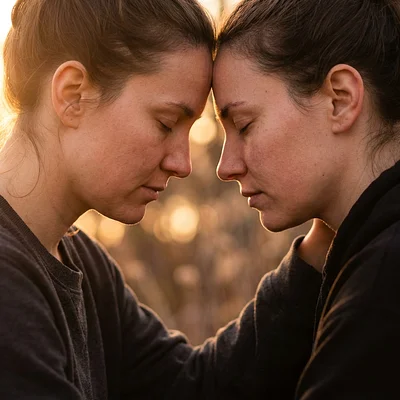

Mia and Jonas sat on their couch with icy silence between them. Three months ago, they'd opened their relationship - one two-hour conversation, five rules on a Post-it, done. Now Mia stared at her phone and Jonas felt like crap because he didn't know which unspoken rule he'd just violated.
The problem wasn't that they'd talked. The problem: They'd had one conversation when they needed seven.
According to recent statistics, 85% of people in open relationships report better communication than those in monogamous partnerships. The key? Not rigid open relationship rules, but structured conversations about what you actually need.
The 7 Conversations for Clear Open Relationship Rules
1. Check Your Emotional Readiness
Imagine your partner comes home from a date. How do you feel? Relieved they had fun? Or is panic already boiling up?
Sarah (32) thought she was ready for polyamory. During her partner Tim's first date, she sat home scrolling through Instagram 47 times. "I'd convinced myself I was so enlightened and free," she says. "In reality, I couldn't even send him a normal text."
Sex therapist Dr. Tammy Nelson warns in Newsweek that opening up "is not a way to save an already faltering marriage." Translation: If you can't talk about your last fight, you definitely can't talk about their new fling. Open relationship trust needs stable foundations.
2. Define Your Relationship Model
Do you want an open relationship, polyamory, or swinging? These are different things with their own polyamory rules. Polyamory means multiple loving relationships, while open relationships often focus on physical experiences. Each model needs its own open relationship rules.
Lisa thought she wanted polyamory. Her partner Marc understood that as: occasional sex with others, but no dates, no sleepovers, no feelings. Three months of misunderstanding because they defined "open" differently. A twenty-minute conversation about definitions would've saved them three months of frustration.
Ready to find like-minded couples? Create couple profiles and connect with others who share similar values.
3. Safer Sex and Health
The condom requirement discussion gets awkward. Have it anyway.
Alex and Jordan had this rule: "Condoms with everyone else, tests every six months." Sounded clear. Then Alex met someone and it "just happened" - and suddenly those clear rules got damn unclear. Does oral sex count? When exactly do you tell your partner - before, after, never?
Johns Hopkins Medicine recommends testing every three to six months with multiple partners. But here's the uncomfortable truth: Most couples talk about PrEP and condoms in hypotheticals ("We would...") until someone's in an actual situation with no idea what actually applies.
Write it down. Literally.
4. Transparency vs. Privacy
Do you want to know who your partner sleeps with? What they did? How it was? Or would you rather live in peaceful ignorance?
This balance is the core of good ENM communication. Some couples share everything - including screenshots and play-by-play. Others go "Don't Ask, Don't Tell" and make it work. Both paths can succeed.
But here's the catch: What you theoretically want and what you emotionally handle can be miles apart. Maybe you think you want details - until you hear them and can't sleep for three days.
Start small. "Tell me when you meet someone, but no details" is a beginning. You can always adjust later.
5. Emotional Boundaries
Can you fall in love with others? Does either partner have veto power? 59% of couples in open relationships cite managing time and emotional energy as their biggest challenge.
Clarify where your boundaries in open relationships need to be so open relationship trust can grow. What happens when feelings develop? How do you manage jealousy in open relationships?
Mark and Sophie never clarified what "primary relationship" concretely meant. Was it a feeling or a calendar slot? When Sophie met someone who could only do Thursdays - their standing date night - Mark exploded: "You're prioritizing someone you've known three weeks over us."
6. Time Management and Priorities
Thursday night was always your night. Then she meets someone who's only free on Thursdays. Who gives in?
Time is measurable. Time is proof of who you truly value. Plan specifically: How many evenings per week go to new connections? Who takes priority in conflicts? These practical questions often determine whether your open relationship rules succeed or fail.
7. Establish Check-in Schedules
The most important conversation is the conversation about having conversations. (Meta, I know.)
The RADAR approach from Multiamory recommends monthly check-ins: Review (what went well?), Adjust (what needs to change?), Discuss (new topics). Sounds like management consulting? Maybe. Works anyway.
Here's the uncomfortable truth: If you want to talk "as needed," you'll never talk. Schedule it. First Saturday of the month, 10 AM, coffee, no phones. Make it routine before you make it a crisis.
What You Should Do Now
Open relationship rules aren't rigid laws - they're emergency plans for moments when emotions run high and nobody can think clearly.
You don't need all seven conversations in one evening. (Please don't do that. It'll be terrible.) But you need the first one: The conversation about when you'll have the other six.
Mia and Jonas from earlier? They're still sitting together on that couch, by the way. But now they're talking. Not about rules - about fears, hopes, and the fact that neither of them has any idea what they're doing. This isn't the romantic version of open relationships you see on Instagram.
But it's the honest one. And honest is the only way this works.
Ready for real connections with people who share your open relationship rules and values? Explore SparkChambers and find partners who value open communication as much as you do. At SparkChambers you'll find verified profiles who value transparency and honesty.