
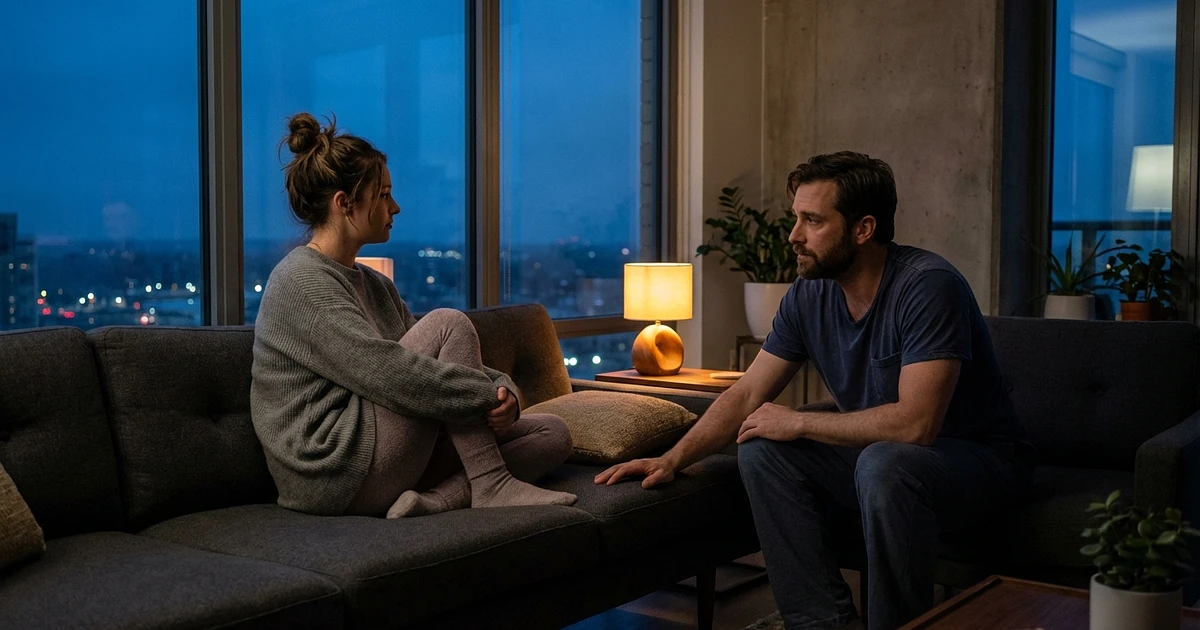
You're lying in bed, staring at the ceiling, and you know exactly where your partner is. With someone else. Your stomach tightens. Your thoughts spiral. You wonder if open relationships were a mistake.
Been there. When I started my first open relationship, I spent one Saturday night at home while my partner was on a date. I tried Netflix, texting friends, everything. But the open relationship jealousy – it was just there, refusing to be distracted.
A 2021 study of 3,438 adults found that 21 to 33% of people in polyamorous relationships struggle with possessiveness and related emotions. This means you're not broken. You're not wrong for open relationships. You're facing one of the most common challenges in this relationship model.
And here's the hopeful part: The same study found that people in open relationships report less jealousy over time than monogamous couples. How does that happen? That's what we're here to explore.
What Open Relationship Jealousy Actually Is
Jealousy isn't a single emotion. This might be the most important sentence in this entire article.
When you search for open relationship jealousy advice, you'll often find simple tips. But the reality is more complex. As counselor Kathy Labriola explains, jealousy is a mix of different emotions. One of her clients described her jealousy like this:
Roughly 50% fear
20% anger
20% powerlessness
10% feeling of betrayal
Your mix probably looks different. And that matters. Because you can't just treat "jealousy" as one thing. You need to know which specific feelings are driving it.
Exercise: Analyze Your Open Relationship Jealousy
Next time you feel jealous, pause. Ask yourself:
How much of this is fear? Fear of being left. Fear of being replaced. Fear of not being enough.
How much is anger? Anger that your partner is doing something that hurts you. Or anger at yourself for having these feelings.
How much is loneliness? That feeling of being excluded while others are having fun.
How much is genuine concern about the relationship?
This breakdown helps. Really. Because each of these emotions needs a different strategy.
First Aid for Acute Open Relationship Jealousy
It's 11 PM. Your partner is out. You notice your heart racing, thoughts spiraling out of control. What now?
Therapist Martha Kauppi, LMFT recommends getting physically grounded before addressing the emotional thoughts. Sounds simple. But when you're in the middle of an anxiety attack, you forget the obvious stuff.
Immediate Techniques Against Jealousy
Breathing: Inhale for 3 counts. Hold for 4. Exhale for 5. According to Healthline, this technique can soothe acute jealousy. I was skeptical. But it actually works. Not because it makes the feelings disappear, but because it pulls your body out of panic mode.
Hand on heart: Place your hand on your chest. Feel your heartbeat. This simple touch activates your parasympathetic nervous system.
5-4-3-2-1 technique: Name 5 things you see. 4 things you hear. 3 things you feel. 2 things you smell. 1 thing you taste. This brings you out of your head and back into your body.
Name the feeling: Say out loud or in your mind: "This is fear." Or: "This is loneliness." Research shows that simply labeling emotions reduces their intensity.
These aren't solutions. They're first aid. The distinction matters.
The Stories You Tell Yourself
You probably know this feeling. You're sitting there, your mind racing, and suddenly you've constructed a complete story: "He finds her more attractive than me." Or: "She's going to take him away from me." Or: "If I were enough, he wouldn't need anyone else."
Martha Kauppi makes a key observation: The stories we tell ourselves during open relationship jealousy feel true. But they often aren't.
In that moment, this feels like truth. But it's a story. An interpretation.
Kauppi writes:
"When I'm with you, I'm with you. When I'm with them, I'm with them. You get to choose the story that you continue to tell."
People in open relationships typically don't compare their partners. It's not a competition. But your anxious brain doesn't believe that.
Identifying and Checking Narratives
When you notice your thoughts racing, write them down. Actually. Grab your phone and type them out. Then read them back and ask:
Is this a fact or an assumption?
Do I have evidence for this?
Is there another explanation?
Would my partner see it this way?
This doesn't instantly change how you feel. But it creates a small distance between you and your thoughts. And that distance is worth its weight in gold.
The Slow Path: From Open Relationship Jealousy to Neutrality
Many articles about open relationship jealousy push "compersion," which is joy at your partner's joy with others. As if that's the natural opposite of jealousy. As if you should jump from overwhelming jealousy straight to happiness.
That's unrealistic. And honestly, unfair.
According to research by Dr. Marie Thouin at UC Berkeley, jealousy and compersion can coexist. They're not mutually exclusive. You can be jealous and happy for your partner at the same time.
But the realistic goal for beginners is: neutrality.
The path looks like this:
Overwhelming jealousy → Manageable jealousy → Neutrality → Maybe eventually compersion
And this path doesn't happen through willpower. It happens through experience.
The Phobia Exposure Model for Open Relationship Jealousy
Kathy Labriola uses an approach she compares to treating phobias. Imagine you have a fear of heights. No therapist would send you straight to the Eiffel Tower. Instead: small steps. First a stool. Then a ladder. Then the first floor. Slowly.
Open relationship jealousy works the same way.
A Real-World Example
Labriola describes Susan, whose husband wanted overnight dates with other partners. Susan had intense jealousy. Instead of jumping straight to overnights, they agreed on steps:
- First just dates, no overnight stays
- Then overnight stays, but rarely
- Then more frequent overnights
- With each step, they waited until Susan felt secure
This took months. But it worked.
Creating Your Own Step Plan Against Open Relationship Jealousy
Maybe your plan looks different. Maybe it's not about overnights, but about:
First just flirting allowed
Then dating, but partner comes home the same night
Then longer dates
Then overnight stays
Or it's about communication:
First no details
Then general info ("I had a nice date")
Then more details when you're ready
There are no rules about how fast this has to go. You and your partner set the pace together.
Scarcity Versus Abundance: A Mindset Shift
Psychological research shows that a scarcity mindset increases open relationship jealousy, stress, and competition. This happens regardless of whether actual scarcity exists.
Scarcity thinking in relationships says: "Love is limited. Attention is limited. If my partner spends time and energy on someone else, there's less left for me."
Abundance thinking says: "Love multiplies. My partner can love multiple people without my love becoming smaller."
I know. Sounds a bit spiritual. But it's actually a practical question.
The Question That Changes Everything
Ask yourself: "What would change if I truly believed that love isn't a finite resource?"
Would you still feel threatened? Would you still compare?
The German polyamory community describes the process as "Entmachtung der Eifersucht" (disempowering jealousy). The goal isn't to completely eliminate jealousy. That would be unrealistic. The goal is to reduce its destructive power.
One community member writes: "If I really do what I want, then I can't be jealous." Another: "When I have lots of contact throughout the day, I become resistant to jealousy."
This isn't a switch you flip. It's repeated experiences that gradually recalibrate your nervous system.
Communication for Open Relationship Jealousy: What Actually Helps
You've probably heard that "communication is important." Sure. But what does that look like in practice?
Ethical non-monogamy experts recommend "processing conversations." These are explicit conversations about jealousy involving all partners.
Studies show that people in open relationships report higher trust in their partners than monogamous people. Couples who are navigating SparkChambers together use exactly this platform to connect with others who share similar values. Not because they're never jealous. But because they've learned to talk about it openly.
What Works
Specific rather than vague: "I was afraid you find her more attractive than me" instead of "I was jealous."
Name your needs: "I need extra reassurance tonight" instead of "You don't care about me."
Watch the timing: Not right after your partner's date. Wait until you're both calm.
No accusations: "I feel scared when..." instead of "You make me jealous because..."
What Doesn't Work
Expecting your partner to "fix" the jealousy
Giving ultimatums
Demanding details that only amplify the jealousy
Selling control as a solution
When Open Relationship Jealousy Is a Real Warning Sign
Not all jealousy is irrational fear. Sometimes it's showing you something important.
Psychology Today identifies several warning signs that jealousy points to real problems:
Red Flags in Your Partner
Your partner deliberately creates insecurity
They compare you to others
They break agreements and dismiss it as "not a big deal"
Controlling behavior: checking your phone, constant tracking, making rules for you but not themselves
Red Flags in the Relationship Structure
The agreements weren't made together
You feel pressured into the open relationship
Basic needs (time, attention, intimacy) are consistently unmet
Growth Opportunities Versus Real Problems with Open Relationship Jealousy
Jealousy is a growth opportunity when:
The basic agreements are being respected
Your partner responds to your feelings
You see progress, even if it's slow
The jealousy decreases over time
Jealousy signals real problems when:
Your partner dismisses or ignores your feelings
Agreements are repeatedly broken
The jealousy stays equally intense for months or gets worse
You feel unsafe in the relationship
When Professional Help Makes Sense
Sometimes books and articles aren't enough. And that's okay.
Seek support when:
Open relationship jealousy significantly impacts your daily life
You develop panic attacks or depression
You and your partner keep falling into the same conflicts
You feel like you can't move forward alone
Important: Find a therapist who's familiar with alternative relationship structures. Not every therapist understands open relationships. A therapist who tells you that open relationships are the problem won't help you.
There are now many therapists who specialize in ethical non-monogamy. The investment is worth it.
The Path Forward: Managing Open Relationship Jealousy
Experiencing open relationship jealousy doesn't mean you're failing. It means you're human.
The German poly community talks about "cellular healing." With each positive experience, with each time your partner comes back and still loves you, your nervous system learns: It's okay. You're safe.
This doesn't happen overnight. It happens in small steps. In conversations. In moments where you dare to be vulnerable. In nights where jealousy comes and you sit with it instead of letting it overwhelm you.
And eventually, maybe, you notice: The jealousy has lost its power. It's still there, sometimes. But it no longer dictates how you live.
That's disempowerment. And it's possible.
Looking for a space where alternative relationships are the norm? Explore the SparkChambers community. Here you'll meet people walking similar paths.