
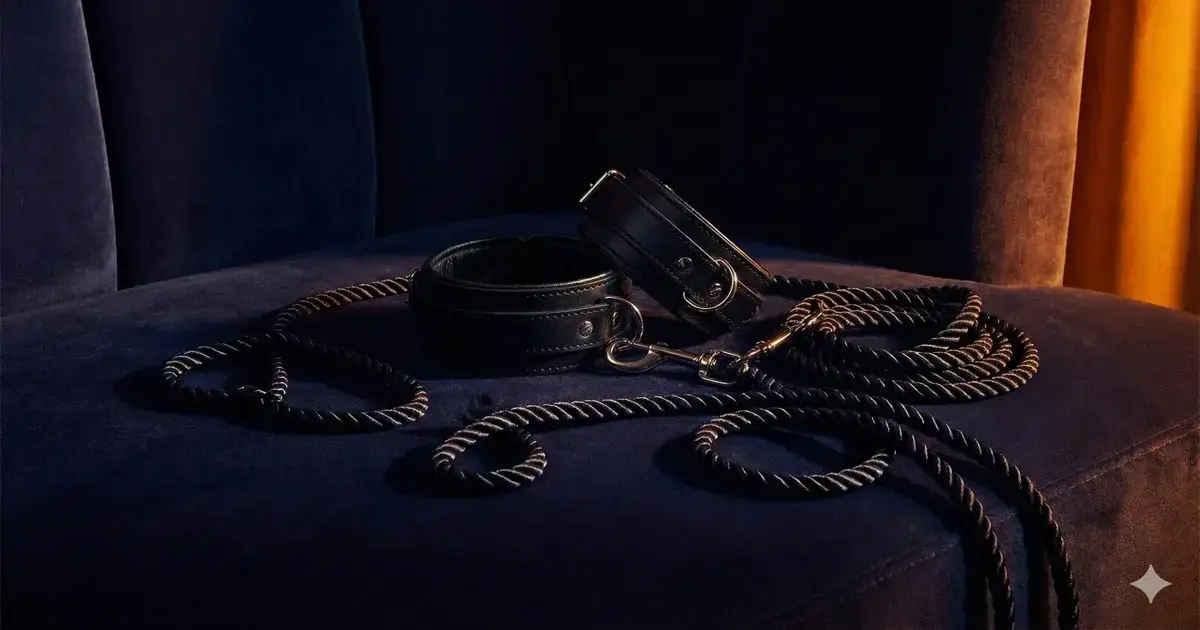
What Is It?
The chastity kink breaks a basic rule your body teaches you: more pleasure equals more release. But what if you flipped it? What if the rule became: the longer you wait, the more alive your whole nervous system becomes.
That's the essence of chastity kink. It's a consensual practice where someone experiences pleasure through the restriction of their sexual release. And yes, it sounds backwards at first. But ask anyone who's actually practiced chastity: that tension doesn't diminish the experience. It becomes the whole point.
In practice, chastity play often involves a physical device (a chastity cage or chastity belt) that prevents the wearer from achieving erection or orgasm. However, the device is just the visible part. The real power of the chastity kink is the dynamic: one partner, the keyholder, controls when (or whether) the other gets release. Male chastity is the most common variation, though chastity practices exist for all genders and body types. Some couples skip the device entirely and rely on willpower and rules alone.
The chastity kink has exploded in popularity. Clips4Sale reported a 71% increase in chastity content sales between 2024 and 2025, crowning it the "Fetish of the Year." Why now? Sex educator Countess Diamond puts it bluntly: chastity is "the ultimate antidote to instant gratification, online porn, and fast hookups." In a world where everything is on-demand, choosing to wait has become its own form of rebellion.
Explore related products: Peniskäfig „Chastity Cage Short“ aus Edelstahl, 289 g schwer, Peniskäfig „Extreme Silicone Cock Blocker“ mit Schloss und Schlüssel.
Peniskäfig „Chastity Cage Short“ aus Edelstahl, 289 g schwer
View at ORIONAffiliate link. Buying through it earns us a commission; the price stays the same for you.
Peniskäfig „Extreme Silicone Cock Blocker“ mit Schloss und Schlüssel
View at ORIONAffiliate link. Buying through it earns us a commission; the price stays the same for you.
Getting Started
Start with conversation, not equipment.
Don't be the person who orders a chastity cage at 2am and surprises their partner. Actually talk about this. Ask the questions that matter: Are you wanting to be controlled, or wanting to control someone? Is the turn-on the waiting, the power imbalance, or watching your partner suffer just a little? These aren't academic questions. Your answers determine literally everything about how you'll enjoy chastity—or whether you'll enjoy it at all. Get them misaligned and you'll be frustrated, uncomfortable, or worse, resentful. Get them right and you've found something genuinely special.
Begin your chastity journey without a device.
Seriously. Try a simple agreement: no orgasm for 24 hours without your partner's permission. Here's what surprises people about chastity play: it's way harder than it sounds. You're not wearing anything. No cage, no reminder, no physical barrier. Just a rule. But your brain creates this constant low-level awareness all day. That text from your partner? It hits. That moment you're alone? Suddenly it's a choice, not automatic. Most people learn within 24 hours whether the psychology of chastity actually works for them, or whether they want the physicality. No device, no expense, just honesty. Both answers are valuable. And you'll actually know which one you are.
If you use a device, size matters.
Measure while completely flaccid, in a comfortable temperature. Most first-time buyers choose a cage that's too large (excited measuring) or too small (based on erect size). Adjustable devices let you fine-tune the fit before committing to a specific size.
The gradual progression rule.
Start with 2-4 hours maximum for your first few sessions. Increase by an hour or two per session over several weeks. Build up to overnight wear only after you've successfully worn the device during waking hours. Your body needs time to adapt.
Always have an accessible spare key.
The fantasy of "no escape" is fun, but medical emergencies don't care about your scene. Keep a spare key somewhere both partners can quickly access it. Safety trumps roleplay, always.