

What Is It?
CNC kink stands for Consensual Non-Consent. It's a form of role-play where partners act out scenarios that simulate non-consensual encounters, but everything happens within pre-negotiated boundaries. The "non-consent" is performed, not real. Both people agree beforehand on what will happen, establish safe words, and can stop the scene at any moment.
Here's the paradox that trips people up: CNC involves enthusiastic consent to play out a fantasy of non-consent. The person in the "receiving" role has actually given detailed permission. They've said yes. They've negotiated the scenario. They hold a safe word that ends everything instantly. The apparent lack of choice is theater, and that theater requires more communication than most vanilla encounters ever will.
This kink occupies edge play territory. It's not something you stumble into on a first date. CNC demands trust built over time, explicit conversations about limits, and partners who genuinely care about each other's psychological safety. When done right, it can create intense intimacy. When done carelessly, it causes real harm.
Explore related products: Handschellen „First-Timer’s Cuffs“, Knebel „Breathable Ball Gag“, Beißball mit Atemlöchern.
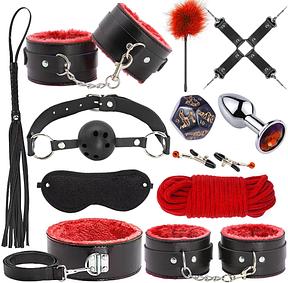
Not available in your region — closest match
View at Amazon (as of Aug 15)Affiliate link. Buying through it earns us a commission; the price stays the same for you.
Knebel „Breathable Ball Gag“, Beißball mit Atemlöchern
View at ORIONAffiliate link. Buying through it earns us a commission; the price stays the same for you.
Why People Enjoy It
The appeal of surrender
For the receiving partner, CNC allows them to experience complete loss of control without the actual dangers. Their conscious mind gets to step back. They don't have to make decisions, perform, or worry about whether they're "doing it right." The responsibility sits elsewhere.
Reclaiming narratives
Some people find that consensually acting out scenarios gives them power over past experiences or fears. This isn't therapy, and shouldn't replace professional support, but many describe a sense of ownership over their fantasy life.
Heightened intensity
The taboo nature creates arousal through psychological charge. The brain struggles to distinguish between real threat and safe simulation, triggering adrenaline and endorphins that amplify sensation.
Deep power exchange
CNC represents an extreme form of dominance and submission. The dominant partner takes on significant responsibility, while the submissive demonstrates profound trust by allowing the scene to unfold.
Paradoxical safety
Counterintuitively, the extensive negotiation CNC requires often makes people feel safer than in vanilla encounters. Everything gets discussed. Boundaries become explicit. Both partners know exactly what's happening and why.
The Spectrum
| Level | Stage | What it involves |
|---|---|---|
| Light | Light | This entry-level CNC play involves verbal resistance during otherwise consensual encounters. Saying "no" or "stop" while giving pre-arranged signals that actually mean "continue." The physical activity might be standard, but the dialogue adds an element of simulated reluctance. Safe words are established but the scenario stays gentle. |
| Moderate | Moderate | Scripted scenarios with clear beginning and end points. One partner might "surprise" the other, but the surprise was scheduled. Includes physical elements like holding someone down or restraining movement. Uses bondage or physical control. The acting is more committed, but the scene has defined limits. |
| Intense | Intense | Extended scenarios with elaborate setup. May involve elements like mock abduction, struggle, or resistance. The receiving partner actively "fights back" while the other overcomes that resistance. Requires extensive pre-planning, multiple check-ins, and thorough aftercare. Not for newcomers. |
| extreme | Extreme | 24-hour or multi-day scenarios. Complete immersion in the dynamic. May involve isolation, ongoing uncertainty about when scenes start or end. Psychological intensity is high. Only for experienced practitioners with deep established trust and strong mental health foundations. |
Getting Started
Start with extensive conversation
Before any physical element, talk. A lot. What does CNC mean to each of you? What scenarios appeal? What's absolutely off the table? These conversations might take weeks. That's fine. Rushing creates danger.
Build your safe word system
"Red" for full stop. "Yellow" for slow down or check in. A non-verbal signal (like dropping a ball or tapping three times) for situations where speaking is difficult. Test these. Use them. Honor them instantly and without question.
Script your first scene
Spontaneity can come later. For your first CNC experience, plan it almost like a screenplay. Who does what, when, and where. What words will be used. What the receiving partner will "do" in resistance. Knowing the beats makes everyone safer.
Start much lighter than you think
If you've fantasized about intense scenarios, begin with something at 20% of that intensity. You can always escalate in future scenes. You cannot undo psychological harm from going too far too fast.
Choose your moment carefully
Both partners need to be in good mental and physical shape. Not after drinking. Not during stressful life periods. Not when either person is tired, sick, or emotionally fragile. The intensity of CNC means everything needs to be optimal.
Safety & Communication
Pre-negotiation is non-negotiable
You need to discuss: specific acts that will occur, acts that are absolutely off-limits, how the scenario begins and ends, safe words and signals, what aftercare looks like. Document this. Write it down. Refer back to it.
The safe word ends everything
When someone uses the safe word, the scene stops completely and immediately. No "just a second." No finishing what you started. Stop. Check in. Provide comfort. This rule has no exceptions. Ever.
Know the psychological risks
CNC can trigger unexpected emotional responses, even in experienced players. Memories might surface. Panic can emerge. Either partner might experience subdrop, top drop, or dissociation. Have a plan for these possibilities.
Aftercare matters more here
After CNC, both partners need care. Hold each other. Talk about what happened. Hydrate. Eat something. Don't leave your partner alone. The receiving partner often needs reassurance that they're loved and respected. The giving partner may need confirmation that they didn't genuinely harm anyone.
Verify your partner
CNC requires trust that's been earned, not assumed. Connecting with verified partners who have established reputations in kink communities adds a layer of safety. Someone you met an hour ago isn't a candidate for this kind of play.
Watch for warning signs
Any partner who dismisses the need for negotiation, mocks safe words, or pushes past stated limits is showing you who they are. Believe them. Walk away. Real dominants in the CNC space take safety more seriously than anyone, not less.