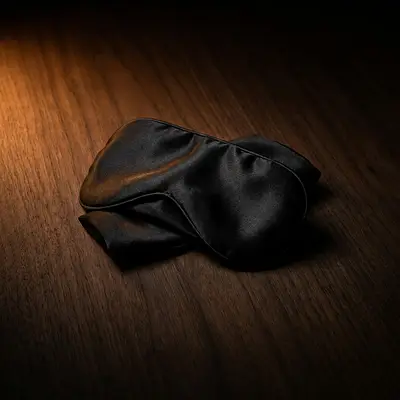
Sensory Play 101: Blindfolds, Ticklers & Low-Temperature Wax
 13 min read

Most people picture whips and dungeons when they hear the word kink. Sensation play is the quiet opposite of all that. It's the art of paying attention: a blindfold, a soft feather, one warm drip of wax, and suddenly your skin is doing all the talking. Sensation play, the broader kink term for deliberately playing with touch, temperature, texture and the loss of a sense, is one of the gentlest and cheapest ways into any of this. And honestly? You probably already own half the gear.
That's the part nobody tells beginners. You don't need a shopping cart to start. A sleep mask you got on a flight works as a first blindfold. A scarf, an ice cube from the freezer, the back of a fingernail. Beginner-focused kink guides like Fight Matrix's sensory play primer call these "pervertibles," ordinary objects repurposed for play, and they work just as well as anything with a price tag.
Before we get into the how, one thing up front. None of this is medical or therapeutic advice, and it's strictly for adults. What it is: a clear, safety-first map of three beginner techniques, plus the consent groundwork that makes them worth doing. Let's start with what the term even means.
What sensation play actually is
Sensation play is any kind of intimate play built around heightening or altering what the body feels, usually by adding a strong sensation (heat, cold, a tickle, pressure) or by muting one of the senses so the rest go louder. Blindfold someone and their hearing sharpens, their skin gets jumpy, a fingertip they'd normally ignore becomes the whole world. That's the mechanism in a sentence. It sits under the umbrella that the kink community calls sensation play, and its most common tools are blindfolds, feathers and ticklers, ice, and low-temperature wax.
It isn't new, and it isn't reckless when done right. The National Coalition for Sexual Freedom, a US advocacy and education nonprofit founded back in 1997, has spent decades documenting the safety and consent practices that hold this kind of play together. So if the idea feels intimidating, it shouldn't. There's a whole culture of care built around it.
Now, the groundwork.
Before you start: negotiation, safewords and consent
Here's where I'd push back on most of the "spice up date night" articles floating around. They skip straight to the wax. That's backwards. The conversation comes first, every single time, and it's genuinely the most important part of any scene.
Talk it through before anyone's blindfolded. What are you curious about? What's a hard no? Where can you be touched and where is off limits tonight? You're setting two kinds of limits here: hard limits, which are non-negotiable, and soft limits, which are maybes you might explore later under the right conditions. Write nothing down if that feels clinical, but do actually say the words out loud.
And skip the alcohol. As Greatist's guide, medically reviewed by Jennifer Litner, PhD, LMFT, CST, points out, agreeing to something once doesn't mean agreeing to it for the rest of the night, so check-ins have to keep happening the whole way through. Consent isn't a signature at the door. It's a running conversation.
Which brings me to safewords. The standard is the stoplight system, and it's beautifully simple. Green means keep going. Yellow means slow down or check in. Red means stop, right now, no questions. Pick these before you begin.
But here's the catch a lot of beginners miss, and it matters more in sensation play than almost anywhere. The moment you take away a sense, a spoken safeword can fail. If your partner is blindfolded and overwhelmed, or their face is covered, "red" might not come out clearly. So you agree on a non-verbal signal too. A common one: the receiving partner holds a small object, a hair tie, a set of keys, and if they drop it, the scene stops instantly. A double tap on the arm works just as well. Set it up in advance, treat it exactly like the spoken word, and never make someone earn their way out.
Plan the aftercare here as well, not later. More on that at the end, but decide now who needs what when the scene winds down.
If you'd rather start with a matched set than raid the sock drawer, a simple beginner bundle covers the basics without overthinking it. Something like this pairs a soft blindfold with light restraints in one box.
Bondage-Set mit Satin-Augenmaske und Handfesseln (Einsteiger-Set)
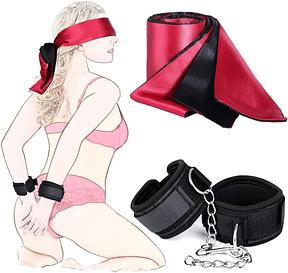
Bondage-Set mit Satin-Augenmaske und Handfesseln (Einsteiger-Set)
View at AmazonAffiliate link. Buying through it earns us a commission; the price stays the same for you.
Blindfolds and sensation play
Blindfolds are the perfect first step, and I mean that. They're low-risk, they need zero technique, and the payoff is immediate. Take away sight and everything else turns up. A breath near the ear, a fingertip tracing the collarbone, the anticipation of not knowing where the next touch lands. That anticipation is honestly the whole point.
That's the basic idea behind sensory deprivation in sensation play: take away one sense and the others turn up to compensate.
Start gentle. For a first go, some people just close their eyes, no blindfold at all, to see how losing sight feels before committing to it. When you do reach for one, a soft fabric mask that blocks light fully beats a scratchy improvised scarf that keeps slipping. Comfort matters, because a blindfold that pinches pulls someone straight out of the moment.
Keep talking while they can't see. Narrate a little, or don't, but check in with your yellow and green. Blindfolded partners can't read your face, so your voice and your touch are the only signals they've got. Move slowly. Vary where and how you touch, because the surprise is what makes it land. A warm palm, then nothing for a beat, then something cool. Their nervous system fills in the gaps.
One caution worth naming: if a partner has any anxiety around not being able to see, or a history of claustrophobia, ease in very gradually or skip the blindfold entirely and dim the lights instead. There's no prize for pushing through discomfort.
For a dedicated mask, a smooth satin blindfold does the job for a few euros, and a two-piece set gives you a spare or one for each partner, useful if sensation play turns into something you do more than once.
Augenmaske „Blind Love“, glatt und seidig
View at ORIONAffiliate link. Buying through it earns us a commission; the price stays the same for you.
2-teiliges Augenmasken-Set „No Peeking“
View at ORIONAffiliate link. Buying through it earns us a commission; the price stays the same for you.
Ticklers, feathers and texture play
Texture play is the most playful corner of sensation play, and the most forgiving. Feathers, ticklers, a soft brush, silk dragged slowly across skin. The goal isn't to make someone laugh (though it might). It's to wake up the nerve endings and keep them guessing.
Why does it work so well? Skin isn't uniform. Some spots are packed with nerve endings and light up at the faintest touch, others barely register. The prime real estate for feather and texture play tends to be the inner arms, the wrists, the back of the neck, the collarbone, behind the knees, the soft skin of the inner thighs. These are the areas where a slow, feather-light drag feels electric. In my experience, the inner wrist gets people every time. Pair a blindfold with a tickler and you've basically doubled the effect, since your partner can't see where the next stroke is coming. That's sensation play at its most playful: quick contrasts, no big commitment.
Some zones ask for more care. Faces near the eyes, obviously. Anywhere the skin is broken, irritated or sunburned. And tickling has a funny edge: for some people, relentless tickling stops being fun fast and tips into genuine distress, even when they're laughing. Laughter isn't consent. Watch for it, and honor your yellow the second it shows up.
A purpose-made feather tickler is cheap and lasts, and the softer ones feel noticeably better than a craft-store feather. Worth the few euros if you find you enjoy this.
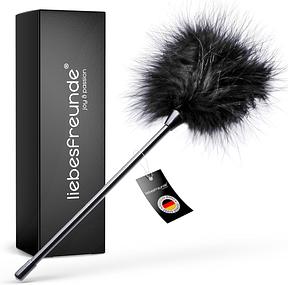
Liebesfreunde® Federkitzler für sinnliche Sexspiele
View at AmazonAffiliate link. Buying through it earns us a commission; the price stays the same for you.
Low-temperature wax play in sensation play: safety first
Okay. This is the section to read twice, because this is the one where getting it wrong actually hurts someone. Wax play is one of the most dramatic tools in sensation play, and it's gorgeous when it's done properly. It's a burn when it isn't. The entire difference comes down to one thing: the candle.
Read this part slowly. Only candles made specifically for skin are safe. That means soy candles or spa and massage candles that are formulated to be poured onto the body. These melt at a low temperature, roughly 80 to 91°F, which feels like a warm drip rather than a scald. Regular household candles, decorative candles, scented candles, tea lights, basically anything from a home-goods aisle, and beeswax candles are dangerous for wax play. They burn much hotter, around 135 to 145°F and up, and that gap is exactly the margin that turns a nice warm drop into an injury.
I want to be blunt about it: do not improvise with a candle off your dinner table. According to Go Ask Alice, Columbia University's health education service, skin-safe massage candles melt well under a roughly 125°F safety threshold, while ordinary and beeswax candles run 10 to 20 degrees hotter, comfortably into burn territory. Same source, same warning. Buy the right candle or don't do this.
Even with the correct candle, technique still matters. A few things I'd treat as non-negotiable:
Hold the candle high. Go Ask Alice recommends 8 to 18 inches above the skin, which gives each drip time to cool on the way down. Higher is cooler and safer.
I always test on a less sensitive spot first, usually the forearm, before anything else touches skin. That's the only way to know exactly how hot this particular candle lands.
I keep a cold, damp cloth within reach the entire time, my first response if a drip feels too hot.
Stay away from the sensitive stuff without extra caution: genitals, nipples, the face, and any broken or irritated skin.
Mind the hair. Wax in body hair is a miserable, sticky removal job, so either avoid hairy areas or lay down a barrier.
Build up slowly. Start with a single test drip, ask your green, then go from there. The heightened, held-breath quality of wax play, and of sensation play generally, comes from trust and restraint, not from dumping half a candle on someone, at least that's how it's gone every time I've watched someone do this well.
For a candle that's actually built for this, one made and sold specifically as a low-temperature body candle takes the guesswork out of it, unlike anything from the kitchen drawer.
Vibratissimo S/M Kerze Mystic Black, Niedertemperatur-Wachskerze
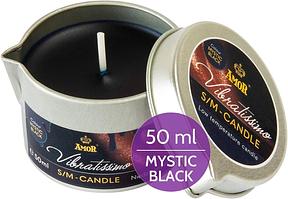
Vibratissimo S/M Kerze Mystic Black, Niedertemperatur-Wachskerze
View at AmazonAffiliate link. Buying through it earns us a commission; the price stays the same for you.
Aftercare
Aftercare is the part beginners skip in sensation play, and regret. Don't. It's not a bonus round, it's part of the whole thing.
After even a gentle scene, bodies and heads come down from something. That can look like a dip in mood, a case of the shivers, or just needing to be held quietly for a while. Aftercare is how you land softly together: water, a blanket, a snack, some reassurance, whatever the two of you decided you'd want back when you were negotiating. Whatever that looks like for you, it's part of sensation play too.
And this isn't just soft sentiment. Clinical psychologist David J. Ley, writing in Psychology Today, frames aftercare as part of "the overarching theme of consent, which includes negotiation, the designation of a safeword, and a collaborative return to a baseline cognitive and emotional state." Within kink communities, a partner who vanishes the moment a scene ends is treated as a red flag, not a minor rudeness. So plan it, and follow through.
Worth saying plainly, since myths cling to this topic: enjoying any of this doesn't mean something's wrong with you. Certified sex therapist Sari Cooper, writing in Psychology Today, points to research showing kink-community members actually report lower rates of adverse childhood experiences than the general population. Curiosity is normal. That's kind of the whole point of learning to do it safely.
Final thoughts
Sensation play is a rare thing in kink: genuinely beginner-friendly, cheap to try, and gentle when you respect the basics. Talk first. Agree on your safeword, spoken and non-verbal. Buy the right candle, never the wrong one. Look after each other when it's over.
Honestly, do those, and the rest is just paying attention to skin. Which, when you slow down enough to actually notice, turns out to be a lot more interesting than most people expect. Curious where else to start? Browse the kink encyclopedia for more techniques like these.
All products from this post
The ones we named above are marked; the rest are alternatives in the same category.
Affiliate notice: As an Amazon Associate, we earn from qualifying purchases. Product prices and availability are subject to change.
Frequently Asked Questions
What is sensation play in a kink context?
Sensation play is intimate play built around heightening or changing what the body feels. That might mean adding a strong sensation like warmth, cold or a tickle, or removing a sense (usually sight, with a blindfold) so the others intensify. Blindfolds, feathers, ice and low-temperature wax are the classic beginner tools, which is why it's such a common first step.
Is wax play safe, and what kind of wax can I use?
Only if you use the right candle. Candles made for skin, meaning soy or spa and massage candles, melt at a low temperature and are formulated to be poured on the body. Ordinary household, scented, decorative and beeswax candles burn far hotter and can cause real burns. Buy a purpose-made low-temperature body candle, hold it well above the skin, and test on your forearm first.
What's the difference between temperature play and wax play?
Temperature play is the wider category: anything that uses heat or cold to create sensation, from ice cubes to warm massage oil to breath. Wax play is one specific form of the warm side, using a body-safe candle. So all wax play is temperature play, but temperature play also includes gentler, lower-stakes options like ice, which are a nice place to start.
Do I need an actual blindfold, or can I just close my eyes?
Either works, and closing your eyes is a great no-cost way to test how losing sight feels before you commit. A real blindfold does more, though, because it removes the temptation to peek and lets the wearer fully let go. A soft fabric mask that blocks light and sits comfortably beats an improvised scarf that keeps sliding off.
Why is a non-verbal safeword so important here?
Because sensation play often mutes the senses. If someone is blindfolded and overwhelmed, or their mouth is covered, a spoken safeword like "red" might not come out clearly. A non-verbal fallback fixes that: the receiving partner holds a small object and drops it to stop everything, or uses an agreed double tap. Set it up before you start and treat it exactly like the spoken word.
Is sensory deprivation the same as using a blindfold?
A blindfold is the simplest, most common form of sensory deprivation, but the idea is broader. Deprivation just means muting one or more senses so the rest register more intensely. A blindfold removes sight; you could add earplugs or soft music to dial down sound too. For beginners, a blindfold alone is plenty to feel the effect.
Sources
- Fight Matrix's sensory play primer fightmatrix.com
- National Coalition for Sexual Freedom en.wikipedia.org
- Greatist's guide, medically reviewed by Jennifer Litner, PhD, LMFT, CST greatist.com
- Go Ask Alice, Columbia University's health education service goaskalice.columbia.edu
- David J. Ley, writing in Psychology Today psychologytoday.com
- Sari Cooper, writing in Psychology Today psychologytoday.com