
Chastity Play for Beginners: Cages, Keyholding, and the Talk That Comes First
 11 min read

Chastity play for beginners usually gets taught backwards. Most guides open with a cage, a size chart, and a buy button, then tuck the actual conversation into a footnote somewhere near the end. We think that order is wrong. The lock is the simple part. The talk you have before anything goes on, and the trust you keep going afterward, is where this whole thing really lives.
So here's the short version, up front. Chastity play is a consensual kink where one adult agrees to let a partner control access to their own orgasm or genitals, often using a device called a cage. It runs on communication, not hardware. Everyone involved is a consenting adult (18 and over), and either person can stop it at any point. That last part isn't a disclaimer. It's the entire foundation.
This is general education, not medical or therapeutic advice. If something worries you, see a doctor. With that said, let's start where chastity play for beginners always should: the conversation.
Chastity Play for Beginners: Start With the Conversation
Before you shop for anything, you talk. Not vaguely, and not "we'll figure it out as we go." You agree on specifics.
Two frameworks get thrown around in kink spaces, and both are worth knowing. SSC and RACK, which stand for Safe, Sane and Consensual and Risk-Aware Consensual Kink, start from the same honest place: no kink activity is truly risk-free, and informed agreement is what makes it work. RACK is just blunter about the risk part. Neither one promises nothing can go wrong. They promise you went in with your eyes open.
And consent here is not a one-time signature. As the National Coalition for Sexual Freedom puts it, every activity needs agreement given out loud or in writing, never assumed from body language or a past scene. That matters more than usual for chastity, because the arrangement can run for days or weeks. Consent you gave on Monday isn't a blank cheque for Friday.
Worth sitting with: in one NCSF community survey, roughly one in three kinky respondents said a negotiated limit had been crossed or a safeword ignored at some point, most often early in their involvement. Beginners are exactly who this happens to. Slow down.
Things to actually pin down before the first lock-up:
How long. A first session might be an hour, not a week.
A safeword, and what it means the moment it's said (usually: unlock now, no debate).
Who holds the key, and how fast they can physically get to you.
What's off the table entirely.
When you'll check in, and how.
Notice that's five things, not a tidy three. Real negotiations are messy like that. A written or spoken yes/no/maybe checklist makes it easier to pin all of this down before the first lock-up.
Being a Keyholder Is a Responsibility, Not a Trophy

If you're the one holding the key in chastity play for beginners, congratulations, you just took on a job. Holding the key doesn't make you "the dominant one" by default, and chastity keyholding isn't a trophy to show off. Really, it just means one thing: you agreed to pay attention.
The core duty is boring and it is everything: stay reachable, and check in. Licensed therapist Jesse Kahn, writing for the Gender & Sexuality Therapy Center, notes that consent "is ongoing and can be revoked at any time," which is precisely why a chastity arrangement needs scheduled check-ins and not just a safeword sitting in reserve. A safeword is an emergency brake. A check-in is looking at the road.
There's a difference between the two that beginners miss. A safeword is for the moment something is wrong. A check-in is a calm, planned "how is this going, honestly?" conversation, and it catches the small problems before they become the safeword kind. As the Sexual Health Alliance explains, safewords exist so everyone can communicate boundaries and feelings more clearly, and that communication doesn't switch off the second a device goes on.
Every keyholder should have an exit plan before they ever hold a key. If the wearer needs out, right now, at 3am, it has to be possible. If that's not possible, don't start. Trust is the whole product here, and nothing kills it faster than "wait until I'm free."
Sizing a Cage: Fit Is the Whole Game
Here's the part every shop leads with when selling a chastity cage for beginners, and the part they usually get slightly wrong. When people talk about chastity cage sizing, they tend to obsess over getting it snug. Forget snug. Correct fit is the actual goal.
A cage has two measurements that matter: the base ring that sits at the base, and the length of the tube. Sizing guidance consistently says to err larger on the ring, not smaller. A common rule is to add roughly half an inch to an inch (about 1.25 to 2.5 cm) to a flaccid base measurement, because a too-tight ring is, in the words of one chastity sizing guide, painful and potentially dangerous, while a slightly loose one is mostly just annoying.
The most common beginner mistake? Measuring once, at the wrong moment. Right after a hot shower, or when you're cold, your body isn't at its everyday size. Measure at a neutral temperature, more than once, on different days, and trust the smaller reliable number.
A beginner-friendly example is the Orion Pubic Enemy No 1, a metal cage sitting in the mid price range that gets used as a first device.
Peniskäfig „Pubic Enemy No 1“, kompatibel mit Reizstromgerät
Whatever you choose, remember the label on the box means very little. The number that keeps you safe is correct chastity cage sizing.
Peniskäfig „Pubic Enemy No 1“, kompatibel mit Reizstromgerät
View at ORIONAffiliate link. Buying through it earns us a commission; the price stays the same for you.
Comfort and Skin: The Small Stuff That Isn't Small
New wearers almost never get taken down by some dramatic emergency. They get taken down by chafing.
Skin irritation, pinching, and rub marks at contact points are the first and most common problem people hit, well before anything circulation-related shows up. Pushing through it doesn't work. Take the device off and let the skin recover. A little water-based lubricant during fitting reduces friction and makes getting in and out far gentler on the skin.
If a spot keeps getting irritated in the same place, that's fit talking to you. Listen to it. Raw skin doesn't mean the cage is "breaking in." It means the fit is wrong.
Affiliate link. Buying through it earns us a commission; the price stays the same for you.
What's Actually Touching You All Day
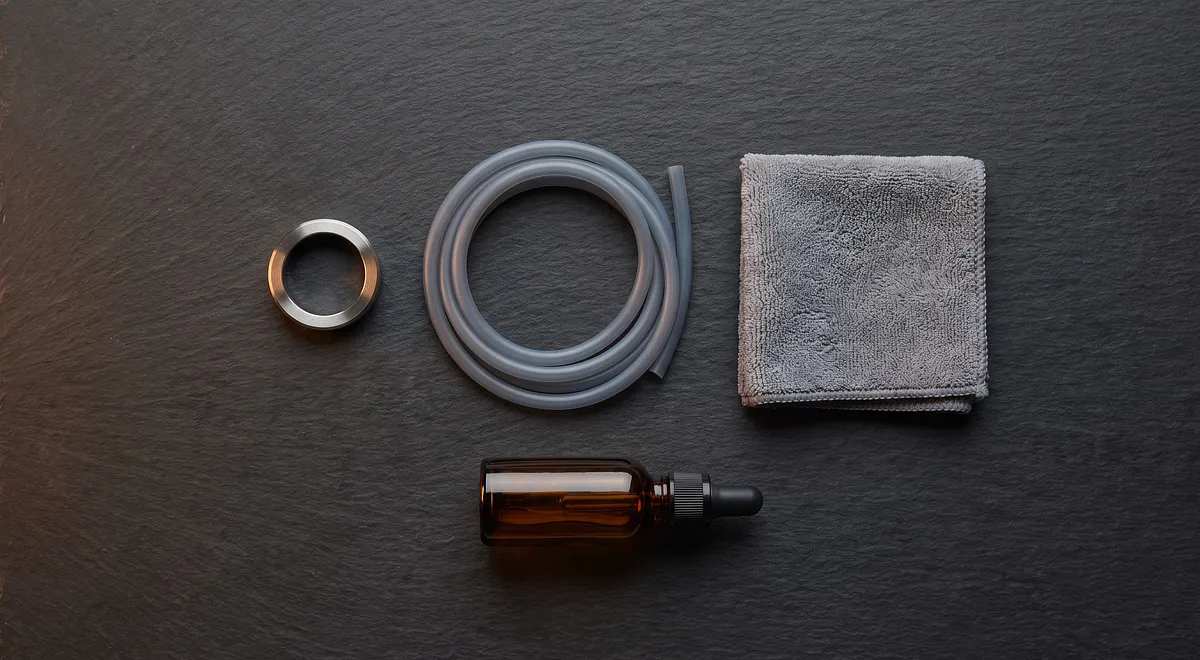
A cage sits against sensitive skin for hours, so what it's made of is not a detail. Stick to body-safe, non-porous materials. In practice that means medical-grade silicone or 316L stainless steel, which are non-porous and can be properly cleaned. Porous or mystery-plastic devices can trap bacteria in ways you can't scrub out, which is a hygiene problem you don't want anywhere near this part of your body.
A second example in the same family is the Orion Pubic Enemy No 2, a slightly larger metal option.
Peniskäfig „Pubic Enemy No 2“, Zubehör für E-Stim-Gerät
Metal and quality silicone both work. What you're avoiding is cheap porous plastic and unlabelled materials that won't tell you what they are.
Peniskäfig „Pubic Enemy No 2“, Zubehör für E-Stim-Gerät
View at ORIONAffiliate link. Buying through it earns us a commission; the price stays the same for you.
The Unsexy Habit That Keeps This Safe
If chastity play for beginners has one unglamorous rule, it's this one. You cannot wear a cage indefinitely and ignore it. That's not a kink rule, it's a body rule.
Most guidance lands on the same rhythm: rinse daily in the shower, and do a full removal at least once a week to wash everything properly and check your skin. Some people remove every few days, and honestly that's a fine instinct, especially when you're new. Give it 20 to 30 minutes off to let the skin breathe. Locked Life's hygiene guide walks through the routine in more detail.
A dedicated toy cleaner makes the weekly clean quicker and more thorough than soap alone, particularly for a device with small parts and tight corners.
EasyGlide Cleansing Spray, 150 ml, Sex Toy Cleaner & Cleanser for Hygienic Cleaning Sex Toys
Dry it fully before it goes back on. Trapped moisture under a cage is how irritation starts.
EasyGlide Cleansing Spray, 150 ml, Sex Toy Cleaner & Cleanser for Hygienic Cleaning Sex Toys
View at AmazonAffiliate link. Buying through it earns us a commission; the price stays the same for you.
Chastity Device Safety: The Line You Do Not Cross
This is the part of chastity play for beginners we won't soften. Fit and hygiene prevent problems here; this section is about catching the rare one early.
Take the device off immediately if you notice numbness, persistent pain, skin that turns pale, blue or grey, coldness, swelling, or open sores. These are signs that circulation might be compromised, and the response is always the same: remove first, ask questions later. Never wait it out.
Why the urgency? Cages that fit rarely cause disasters. The urgency is about physiology, and physiology is genuinely time-sensitive. Urology makes this clear in a different context: the European Association of Urology's guidelines treat sustained loss of blood flow in genital tissue as a medical emergency where outcomes get worse by the hour, not a "sleep on it" situation. That guidance isn't about chastity cages specifically, and we're not saying cages cause that condition. We're saying the general lesson, that the body does not tolerate cut-off circulation for long, is exactly why correct fit and prompt removal matter.
One more distinction beginners get wrong. A cock ring used for arousal is generally worn for only 20 to 30 minutes at a stretch, because it deliberately restricts. A chastity cage is worn far longer, which is the whole reason it must fit rather than squeeze. Same underlying principle, completely different device.
If symptoms don't settle quickly after you remove the device, get medical help. A doctor has seen stranger things than a chastity cage, we promise, and your health matters more than a moment of awkwardness.
If You Take One Thing From This
Buy the cage last. That's chastity play for beginners in one line: talk first, cage last. The order that keeps this safe and good is the reverse of how it's usually sold: talk it through, agree on limits and check-ins, sort out who can unlock you and how fast, then think about hardware. The device is downstream of the trust, always.
Start with an hour, not a month. Keep talking. And if you want to understand the wider vocabulary, consent, negotiation, safewords and aftercare, our kink encyclopedia is a decent place to explore at your own pace, no pressure and no judgement.
All products from this post
The ones we named above are marked; the rest are alternatives in the same category.
Affiliate notice: As an Amazon Associate, we earn from qualifying purchases. Product prices and availability are subject to change.
Frequently Asked Questions
How long can a beginner safely wear a chastity cage?
Start small, like an hour or an evening, not days. There's no universal safe maximum, because it depends entirely on fit and your own body. Remove it daily to rinse and at least weekly for a full wash and skin check. If anything hurts or goes numb, take it off right away. This is general education, not medical advice.
Does a chastity cage need to be tight to work?
No. Tightness is the mistake, not the goal. A cage works through correct fit, not constriction. Erring slightly larger on the base ring is standard advice, since a too-tight ring risks pain and circulation problems while a slightly loose one is mostly just fiddly. Fit is the actual safety lever.
What should we agree on before starting?
Duration, a safeword and what it triggers, who holds the key and how quickly they can reach you, hard limits, and a check-in schedule. Consent is ongoing and revocable, so treat that first conversation as the start of many, not a one-off contract. Either person can end it at any time.
What materials are safe for a chastity cage?
Body-safe, non-porous ones: medical-grade silicone and 316L stainless steel are the usual picks, because they can be cleaned properly and won't trap bacteria. Avoid cheap porous plastics and unlabelled materials. Whatever the material, clean it on a regular schedule and dry it fully before wearing.
Does this guide only apply to male anatomy?
No. You'll sometimes see this called a male chastity guide, but the negotiation, sizing, and safety principles here work for any body wearing a chastity device, not just cisgender men.
When should someone stop and seek help?
Immediately, if there's numbness, persistent pain, pale or bluish skin, coldness, swelling, or sores. Remove the device first, every time, and don't wait to see if it passes. If symptoms don't ease soon after removal, contact a doctor. Prompt removal is the safe default, and no arrangement is worth risking your health over.
Sources
- SSC and RACK en.wikipedia.org
- National Coalition for Sexual Freedom ncsfreedom.org
- Gender & Sexuality Therapy Center gstherapycenter.com
- Sexual Health Alliance sexualhealthalliance.com
- chastity sizing guide honeysx.com
- 316L stainless steel yogilinga.com
- Locked Life's hygiene guide lockedlife.co.uk
- European Association of Urology's guidelines uroweb.org