
SSC vs RACK vs PRICK: The Three Kink Safety Frameworks, Compared
 14 min read
The person who coined "safe, sane and consensual" spent the following decades wishing the phrase had stayed in the meeting room it was written in. Not because he thought kink should be dangerous or coerced. Because three words that fit on a button stopped being a guideline and started being a loyalty test. That detail is missing from almost every SSC vs RACK explainer online, and it's the one that makes the rest of the argument legible.
Why kink ended up with slogans in the first place
These acronyms weren't invented for internal bookkeeping. They were built partly as an answer to people outside the room.
The size of that outside pressure is measurable. Research published in European Psychiatry in 2022, comparing 256 BDSM practitioners with 300 matched controls from the general Belgian population, found that roughly 86% of the general-population sample held stigmatising beliefs about BDSM interests and practices. When most of the room outside your door assumes what you do is pathology, a short, quotable ethical standard is a useful thing to own.
So a kink safety framework does two jobs at once. It's a negotiation tool for the people in the scene, and it's a public statement to everyone who isn't. Those two jobs pull in different directions, and that tension is basically the whole story of what happened next. That's the pressure SSC, and later RACK and PRICK, were built to answer.
SSC: safe, sane and consensual (1983)
The phrase was coined in 1983 by david stein, who writes his name in lowercase, on a three-person committee of New York's Gay Male S/M Activists drafting a statement of purpose. It spread fast through the 1980s leather community, then well past it.
What he meant by it was looser than what it became. His own gloss points at the phrase "have a safe and sane Fourth of July": don't burn the house down, don't blow your hand off. A vague, friendly reminder to not be an idiot with fireworks. Not a certification standard.
What went wrong with SSC
Then it hit T-shirts.
Stein's own line on this is blunt: "Once an idea is reduced to a slogan that can fit on a button or T-shirt, no one can control its meaning." He watched a loose guideline calcify into what he called an all too rigid ideology, to the point where he considered the phrase more of an obstacle than a help. He also wrote the sentence I'd staple to the front of every negotiation guide ever published: "Being SSC alone is not enough."
The specific complaints stack up like this.
"Safe" isn't true and everyone knows it. Kink educator Kessily Lewel argues that "BDSM isn't safe. Neither is skydiving, skiing, hang-gliding, gymnastic, or anything else." Calling a rope scene "safe" doesn't make it safe. It just moves the conversation away from the actual hazards, which is the opposite of what you want.
"Sane" does judgement work it was never qualified to do. As kink-aware therapist Sarah Chotkowski, LICSW, explains, one person's hot is another person's insane, and the word carries stigmatising weight for people with mental illness who are perfectly capable of consenting to kink. Worth being fair here: the contemporaneous reading of "sane" was closer to "knowing the difference between fantasy and reality" than to any clinical diagnosis. Both the original intent and the later critique are real. The critique won anyway, because words don't keep their original intent when they travel.
It became a weapon. Once "SSC" was the community's public respectability badge, "that wasn't safe, sane and consensual" turned into a way to dismiss other people's kinks rather than a way to check your own. Some critics call the result vanillification: safety framing sanded down the risk-taking that, for a lot of practitioners, is part of the point.
RACK: risk-aware consensual kink (1999)
RACK was a direct answer, and unusually for community terminology, it has a date on it.
Gary Switch didn't like SSC, and on 25 November 1999 he said so on the Eulenspiegel Society's TES-Friends mailing list (a date you can actually check, per Anne O Nomis's history of the two frameworks). His pitch: "safe" was a lie that made everyone worse at risk, and "sane" was nobody's business but the person feeling it. His line: "Nothing's perfectly safe. Crossing the street isn't safe either."
The analogy he reached for was mountain climbing. Risk isn't a bug in the activity, it's load-bearing. You don't eliminate it. You shrink it through study, training, technique and practice, then you accept what's left with your eyes open. Wikipedia's entry on risk-aware consensual kink covers the fuller etymology if you want the paper trail.
RACK caught on hardest among people doing things SSC couldn't honestly describe. Anything in the breath play family, fire, needles, heavy bondage with no quick release. "Safe" is the wrong word for those. "Risk-aware" is at least an accurate one.
Risk awareness is gear choices, not a mood
Here's where RACK earns its keep, and it's the bit that reads as abstract until you make it concrete.
Risk awareness isn't a feeling you have about a scene. It's a series of small, boring, specific decisions made before anything starts. Which limb you tie and which you leave free. Whether the hardware releases under load. Whether the thing touching skin for forty minutes is going to compress a nerve.
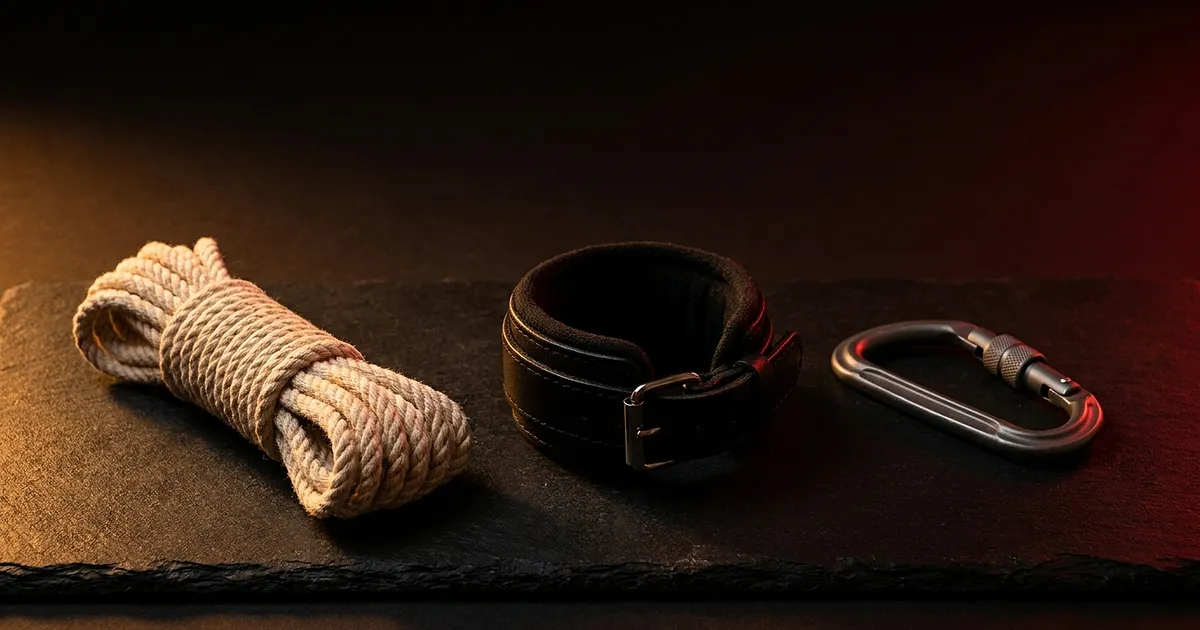
Restraints are the clearest example. A hard, thin, unlined cuff concentrates pressure on a narrow band of wrist, right where the ulnar nerve sits close to the surface, and a wearer who's floating won't reliably notice numbness before it matters. A soft, padded, correctly-sized cuff spreads that load. A leather cuff set that's padded and cut for narrower wrists is what "risk-aware" looks like when it stops being a philosophy and becomes a purchase.
That's the whole idea. You can recite risk awareness all day. Choosing the restraint that doesn't crush a nerve is what actually demonstrates it.
Where RACK falls down
Most articles treat RACK as the upgrade that fixed SSC and stop there. It isn't settled, and the criticism comes from a decent height.
A 2014 peer-reviewed paper by sociologist D.J. Williams and colleagues argued that SSC and RACK both "appear to have significant practical and conceptual limitations," and proposed a different model entirely. That's a rare and useful finding, because almost nothing in the community literature scrutinises RACK with the same energy it spends on SSC.
The practical failure mode is easy to describe. "Risk-aware" has no floor. Nothing in the acronym says how aware, or aware compared to what, or who had to do the reading. Two people can agree they're risk-aware, mean completely different things by it, and only find out which one of them was wrong afterwards. In its worst form the label launders under-preparation: say the words, skip the study, call the result consent.
And RACK is vague about who owns the risk. "Consensual" is mutual by definition, which quietly leaves the question of who was supposed to know about nerve compression unanswered.
PRICK: personal responsibility, informed consensual kink (around 2009)
PRICK kink answers exactly that question. Personal Responsibility, Informed Consensual Kink. Each adult owns their own risk, and "informed" means you're expected to go find out rather than assume your partner did.
Before going further, an honesty note, because this is where a lot of articles quietly bluff.
PRICK's origin story is thinner than the other two, and that matters
SSC has a committee and a year. RACK has a named person, a named mailing list and a date you can check. PRICK has neither.
Community writing commonly places its coinage around 2009 and attributes it to a writer using the handle "Mythos." Every source that says so rests on community-internal writing rather than a dated, documented publication. I couldn't verify a primary citation for it, and I'd rather say that plainly than dress a community attribution up as an established fact.
That gap isn't a footnote, it's informative. It shows how kink vocabulary usually spreads: sideways, through forums and workshops and conversations, with no institution keeping minutes. SSC and RACK are the unusual ones for having a paper trail at all.
What PRICK adds, and where it strains
The useful part is the shift in grammar. RACK says we are aware of risk. PRICK says you are responsible for the risk you agreed to, and you're responsible for learning what you agreed to before you agree to it.
In a D/s dynamic that's a meaningful correction. It stops "the dominant handles safety" from becoming an unexamined default, which is a load nobody should be carrying alone and which, incidentally, makes the submissive's job passive in a way that gets people hurt.
The strain is obvious once you say it out loud. Push personal responsibility far enough and it becomes an exit route: you consented, so whatever happened is on you. Chotkowski's framing is the corrective worth holding onto here, that responsibility for safety in a dynamic is collaborative rather than one person's burden. PRICK is meant to add a layer of individual accountability, not to delete the shared one.
The other honest criticism is that PRICK has never really been codified. There's no founding essay to argue with, no canonical definition, and in practice people use it to mean slightly different things.
SSC vs RACK vs PRICK: the comparison
| SSC | RACK | PRICK | |
|---|---|---|---|
| Stands for | Safe, Sane and Consensual | Risk-Aware Consensual Kink | Personal Responsibility, Informed Consensual Kink |
| Origin | 1983, GMSMA committee, New York | 25 Nov 1999, Gary Switch, TES-Friends list | ~2009, commonly attributed to "Mythos" (community sourcing only) |
| Core claim | Play should be safe, sane, consensual | Nothing is safe; know the risk, then consent to it | Inform yourself first, and own the risk you accept |
| Reacting against | Outside claims that kink equals abuse | SSC's false promise of safety, and "sane" as judgement | RACK's unassigned responsibility |
| Fits best | Public-facing ethics, absolute beginners | Edgeplay and anything with irreducible risk | Experienced adults, explicit power exchange |
| Fails how | Vague words carrying heavy loads | "Risk-aware" with no floor under it | Slides toward "your problem now" |
SSC vs RACK vs PRICK: how do you choose?
Short version: most people don't, and the research suggests they're right not to.
A 2024 study published in Archives of Sexual Behavior surveyed 202 BDSM practitioners (ages 18 to 83, mean age 40.2) on how acceptable they found various consent-communication practices. The headline finding is in the title: consent norms in this community are strong but not inflexible. Ratings shifted by context. How much negotiation felt necessary depended on whether the scene was pick-up play with a stranger or something inside an established romantic relationship.
That's not people being sloppy. That's people applying a standard proportionally, which is what a competent adult does with any risk framework. Nobody runs the same pre-flight check for a blindfold that they run for suspension.
So the question isn't which acronym you pledge allegiance to. It's which parts of each you actually use.
Take SSC's job, not its wording. Its real function was drawing a bright line between consensual kink and abuse. That line is still worth drawing. The specific three words are the weak part, not the purpose.
Take RACK's honesty. Say out loud what can go wrong, in specifics, before it can. "There's a nerve here and if your hand goes numb we stop" beats any adjective, and a safeword or check-in system is what makes that promise enforceable mid-scene.
Take PRICK's homework clause. Both people read up. Neither outsources their own understanding of the risk to the other, however the power is arranged inside the scene.
Then write it down somewhere concrete. This is where the philosophy stops and the paperwork starts. A yes/no/maybe checklist turns any of these frameworks into a list of things you've actually discussed, which is the only version that survives contact with a real scene.
And expect to recalibrate. New partner, new activity, new risk tolerance after something went sideways. The framework is a starting vocabulary, not a signature you can't withdraw.
Beyond the three
The debate didn't stop at PRICK, either. The Williams et al. paper proposed the "4Cs" as an alternative: Caring, Communication, Consent and Caution. It's rare in casual conversation and you probably won't hear it in a club, but its existence is the point. Researchers looked at the whole genre of terse safety acronyms and concluded the genre itself under-serves negotiation.
I think that's the most useful thing to take from any of this.
What this is actually for
Forty years of argument, and the most quoted line still belongs to the person who started it: being SSC alone is not enough. Swap in RACK or PRICK and the sentence holds. Whichever side of the SSC vs RACK debate you land on, no acronym has ever made a decision for anyone.
What they're genuinely good for is giving two people a shared vocabulary before a scene, so that "I want to be careful about this" and "I want to be reckless about this" are distinguishable sentences. Pick the words that make your partner tell you the truth about what they're worried about. That conversation is the safety measure. The slogan is just the invitation to have it.
If you've never planned a scene together with the person you play with, that's the next thing to do, and it doesn't require picking a side.
Frequently Asked Questions
What does SSC mean in kink?
SSC stands for Safe, Sane and Consensual, coined in 1983 by david stein for a Gay Male S/M Activists committee statement in New York. It was meant as a casual reminder not to be reckless, not a certification standard. Stein spent the following decades watching it get used exactly the way he warned against, which is why his own verdict on it stuck: "being SSC alone is not enough."
What is the difference between SSC and RACK?
SSC claims play should be safe. RACK kink, coined by Gary Switch in November 1999, says nothing is truly safe and asks you to understand a risk before consenting to it. RACK also drops "sane" entirely, on the grounds that one person's judgement of another's kink isn't a useful safety criterion.
What is PRICK, and how is it different from RACK?
PRICK stands for Personal Responsibility, Informed Consensual Kink. It keeps RACK's risk awareness and adds that each adult is responsible for informing themselves, rather than assuming a partner has done the research. Its origin is thinly sourced: community writing places it around 2009 and attributes it to a writer called "Mythos," without a documented publication behind it.
Is one kink safety framework safer than the others?
No framework makes anything safe by itself. RACK and PRICK describe risk more honestly than SSC does, which tends to produce better conversations. But the safety comes from the preparation, the negotiation and the gear choices, not from which acronym anyone uses to describe them.
Can you blend SSC, RACK and PRICK?
Yes, and most experienced practitioners effectively do. A 2024 study of 202 BDSM practitioners found consent norms are strong but flex by context rather than following one fixed rulebook. Treating the acronyms as overlapping vocabulary, rather than teams to join, matches what people actually do.
Why do people say a scene was "not safe, sane and consensual"?
It's usually shorthand for "that looked reckless or coerced to me." Critics point out the phrase gets used to police unfamiliar kinks rather than to examine anyone's own preparation, and I think that's the real tell: judging someone else's scene is easier than doing your own homework, which is exactly why RACK was proposed as a replacement in 1999.
Sources
- Research published in European Psychiatry in 2022 ncbi.nlm.nih.gov
- david stein toloveandplay.com
- Kessily Lewel argues kessilylewel.com
- Sarah Chotkowski, LICSW, explains thepomegranateinstitute.com
- Anne O Nomis's history of the two frameworks historyofthedominatrix.com
- Wikipedia's entry on risk-aware consensual kink en.wikipedia.org
- 2014 peer-reviewed paper by sociologist D.J. Williams and colleagues semanticscholar.org
- 2024 study published in Archives of Sexual Behavior link.springer.com