Sadomasochism Explained: What S&M Means and How It Differs From D/s
 15 min read
Most people picture a sadist as a Dominant holding a paddle, and a masochist as the submissive kneeling in front of them. Tidy picture. It's also wrong often enough to cause real confusion. Sadomasochism describes how someone relates to intense sensation, pain included. Dominance and submission describe who holds the power. Those are two different sliders, each set on its own, and where someone sits on one tells you surprisingly little about the other.
That's why this guide is built around four combinations rather than two labels. First, though, the words themselves.
What Does Sadomasochism Actually Mean?
Sadism is taking pleasure in giving pain, discomfort or intense sensation to someone else. Masochism is taking pleasure in receiving it. Put the two together and you get sadomasochism, usually shortened to S&M or S/M. Someone who enjoys both sides is sometimes called a sadomasochist.
In a kink context, every one of those definitions carries an invisible clause: with a willing partner who agreed to it. Take the consent away and you're not describing sadomasochism in the sense the kink community uses the word. You're describing harm.
The words are older than the scene that uses them. Both come from writers. The Marquis de Sade wrote novels far darker than anything a modern play partner would sign off on, and Leopold von Sacher-Masoch wrote Venus in Furs, about a man who begs a woman to dominate and whip him. The psychiatrist Richard von Krafft-Ebing turned both surnames into clinical terms in the 19th century, as the Wikipedia entry on sadomasochism lays out. (An odd fate for two novelists, ending up in a psychiatry textbook.)
That clinical history mostly matters today as a source of confusion, which we'll get to. In everyday kink vocabulary, sadomasochism just names a preference about sensation.
What's the Difference Between a Sadist and a Masochist?
Sadism vs. masochism comes down to direction, not personality type: within sadomasochism, a sadist enjoys giving intense sensation and a masochist enjoys receiving it. Neither label says a thing about who's in charge.
What the dictionary versions leave out is why people enjoy it, and the answers vary a lot. For some masochists it's the rush after a hard impact. For others it's the challenge of taking more than they thought they could, or the way pain pulls all their attention into the body and switches the noisy part of their head off for a while. Sadists tend to describe the flip side: watching a partner's reactions closely, controlling the intensity, and the trust it takes to be allowed to hurt someone who actually wants it.
Masochism in practice can look like:
enjoying a hard spanking, a crop or a flogger
wanting nipple clamps or clothespins left on a bit longer than is comfortable
temperature play with ice or wax, for people who like the shock more than the warmth
scratching, biting, hair pulling... honestly the list gets long, and it's personal
the mental side, for some, like being told exactly how much it's going to hurt before it does
And it isn't all or nothing. Plenty of people love one kind of pain (a sharp sting) and hate another (a dull ache). "Masochist" is a broad word covering very specific tastes, and the same goes for "sadist." Our Kink Spectrum glossary maps where sadomasochism sits among everything else, so we won't catalog kinks here.
Is S&M the Same as BDSM?
No. Sadomasochism is one part of BDSM, not a synonym for it. BDSM is an umbrella acronym, and sadomasochism (S&M) supplies the last two letters.
The acronym is usually read as three overlapping pairs:
| Letters | Stands for | What it's about |
|---|---|---|
| B/D | Bondage and discipline | Restraint, rules, correction |
| D/s | Dominance and submission | Power, and who holds it |
| S/M | Sadism and masochism | Pain and intense sensation |
So someone can be deeply into BDSM with no interest in pain at all. A person who loves rope and being told what to do, but hates being hit, is practicing BDSM with the S&M slider set to zero. It works the other way too. Some couples do nothing but impact play, with no rules or titles and no power exchange, and that's still BDSM. Just a narrow slice of it.
People use "S&M" as shorthand for all of BDSM mostly because it's the most dramatic-sounding part. I'd guess Rihanna's 2011 single "S&M" did more to spread the abbreviation than any sex educator ever managed, which is a slightly depressing thought if you're a sex educator.
S&M vs D/s: Two Different Sliders
Here's the frame the rest of this guide hangs on. Sadomasochism is a slider about sensation. At one end you want to give intense physical stimulation; at the other you want to receive it. D/s is a slider about power. At one end you want to lead, set rules and make decisions; at the other you want to follow them.
They don't move together.
The kink community already has vocabulary that splits them. Top and bottom describe who performs the physical action in a scene and who receives it. Dominant and submissive describe who holds authority. A bottom taking a caning can be the person who planned the whole scene and decides when it stops. Two word pairs exist precisely because one pair can't do both jobs. For the D/s half explained properly, read our guide to what Dominant and submissive roles actually are; this piece won't repeat it. (For scale: the same 2015 survey cited further down found 22% of US adults had tried Dominant/submissive roleplay, per Psychology Today.)
The educators at KYNK 101 put it bluntly: sadistic and masochistic kinks are not required to be either dominant or submissive. A Dominant can be a masochist, they write, "just as much as a brat can be sadistic." I think that one line clears up more beginner confusion about sadomasochism than most full-length guides do.
Is a Sadist Always the Dominant One?
Often, not always. A sadist is often Dominant and a masochist is often submissive, but that's a common pairing in sadomasochism, not a rule. All four combinations of the two sliders exist, and each looks different in practice.
Laid out as a grid:
| Dominant (leads) | Submissive (follows) | |
|---|---|---|
| Sadist (gives sensation) | Sadistic Dominant | Submissive sadist |
| Masochist (receives sensation) | Dominant masochist | Submissive masochist |
The scenarios below are illustrations, not scripts. Real dynamics get negotiated couple by couple.
The Sadistic Dominant
The combination everyone pictures, and a genuinely common one. The Dominant partner sets the rules and also enjoys delivering pain. A scene might open with instructions ("hands on the headboard, count every stroke") and move into impact. Power and sensation run in the same direction here, which is exactly why people assume Dominance and sadomasochism are one thing.
The Submissive Sadist
Less obvious. Still real. This person likes following a partner's lead, yet what they enjoy doing is giving pain. One way it plays out: a Dominant orders their submissive to deliver strokes, maybe to a third partner, maybe to the Dominant themselves, entirely on the Dominant's terms. The submissive gets to be sadistic because they were told to, and they stop the second they're told to stop. KYNK 101's "sadistic brat" is a close cousin, pushing against the rules while still wanting to be the one handing out sensation.
The Dominant Masochist
Probably the combination that surprises people most. The masochist runs the scene: what gets used, how hard, how many, when it ends. Their partner carries out the instructions. Some people call this "topping from the bottom" and mean it as a criticism. I think the phrase gets thrown around too much. When everyone agreed to the arrangement upfront, it's simply a Dominant who likes pain.
The Submissive Masochist
The mirror image of the first pairing and the other half of the stereotype. They hand over control and receive sensation. It's common for the same reason the sadistic Dominant is: when both sliders point the same way, there's less to negotiate.
People Who Sit Off the Grid
Not everyone fits a box. A switch moves between roles on either slider, or both, depending on partner or mood. Some people sit firmly at one end of the D/s slider and don't register on the sadomasochism slider at all; a strict 24/7 power-exchange couple who never use pain is entirely normal. And two masochists can date each other happily, then either skip sadomasochism as a couple or find it elsewhere by agreement.
So where does the stereotype come from? Mostly from fiction and film that fold pain and power into one character, the brooding Dominant who is also, conveniently, a sadist. It makes for simpler storytelling. It makes for worse self-understanding. If you've tried to read yourself into that stereotype and something felt slightly off, the grid might be why.
What S&M Looks Like in Practice
A lot of real sadomasochism is less theatrical than people expect. Two common entry points show how the sliders turn up in actual gear.
Impact Play
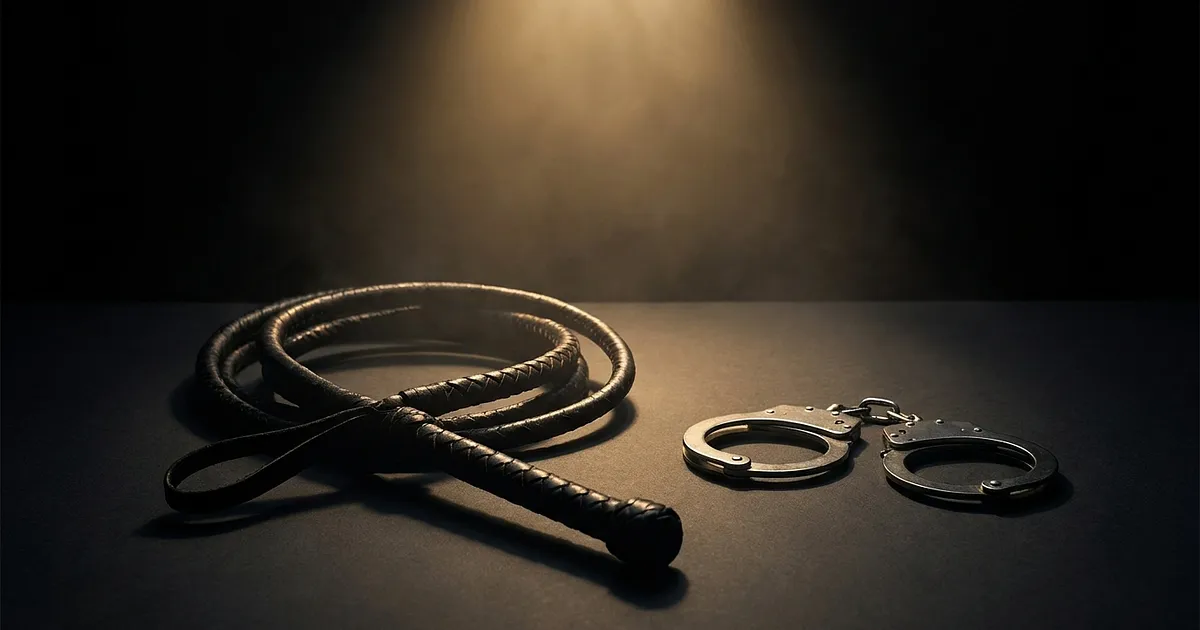
Impact play (spanking, paddles, crops, floggers) is probably the most familiar form of sadomasochism, and it's where the sensation slider is easiest to see. A crop lands as a small, sharp sting, nothing like the broad thud of an open hand. A basic riding crop is a typical example of the kind of tool involved: precise and easy to control, which is why crops turn up so often in beginner setups. How hard is always negotiated, never assumed.
It's also more mainstream than it sounds. In January 2023 Psychology Today reported on a nationally representative 2015 survey of 2,021 US adults in which 30% had tried spanking. Flogging came in lower, at 13% in that same survey.
If this is all new to you, our BDSM for beginners guide covers the practical starting points, from negotiation to aftercare.
Restraint and Control
Restraint is a useful example of sadomasochism precisely because it doesn't belong to one slider. A pair of metal handcuffs can serve the power slider (being held in place, unable to stop what's happening), the sensation slider (metal is hard and unforgiving against the wrists), or both at once. That hardness is also why metal cuffs aren't the thing to struggle hard against. In the same 2015 survey, 20% of adults said they'd used restraints, and I'd bet most of them never thought of themselves as sadists or Dominants.
Harder and riskier practices sit further out on the scale. We cover where that line runs in What Counts as Edge Play?, which is worth reading before anything beyond the basics.
Is Sadomasochism a Mental Disorder?
Not on its own, no. The DSM-5, the diagnostic manual psychiatrists use, separates an unusual sexual interest from a disorder, and consensual sadomasochism between adults falls on the interest side.
The distinction is spelled out by psychiatrist Michael B. First, an editor on the DSM-5 text revision, in a 2014 paper in the Journal of the American Academy of Psychiatry and the Law. The manual defines a paraphilia as a persistent, intense, atypical arousal pattern, whether or not it causes any problems. A paraphilic disorder needs more: clinically significant distress or impairment, or acting on the interest with someone who didn't consent. For Sexual Sadism Disorder specifically, behavior with a consenting partner is explicitly excluded from the diagnosis. Most people with masochistic interests, First notes, don't meet the criteria for a disorder at all.
That matters because a lot of search results on sadomasochism still read like symptom checklists. Several mental-health clinic blogs lead with the disorder label and never mention the consent carve-out, which is a bit like describing a glass of wine purely in terms of alcoholism.
Research on actual practitioners points the same way. A 2013 study in The Journal of Sexual Medicine by Andreas Wismeijer and Marcel van Assen compared 902 BDSM practitioners with 434 people who didn't practice BDSM. The practitioners came out less neurotic, more extraverted, more open to new experiences, more conscientious, less rejection-sensitive, and higher in subjective well-being. Basically every measure ran in their favor. The authors suggested BDSM might be better understood as recreational leisure than as the expression of anything pathological. One study doesn't settle everything, and its sample was self-selected. It's still a long way from the "something must be wrong with them" assumption.
This isn't abstract, either. The National Coalition for Sexual Freedom has tracked child-custody cases where a parent's kink was used against them. According to NCSF's figures as summarized on Wikipedia, reported cases fell from 124 in 2008 to 15 by 2017. The DSM-5, with its clearer interest-versus-disorder line, came out in 2013, between those two points. That's advocacy data, not a controlled study, so I'd read it as a signal rather than proof. Still a striking pair of facts.
None of this is medical advice. If your own interests genuinely distress you, a kink-aware therapist is the right person to talk it through with, and NCSF keeps a Kink Aware Professionals directory for exactly that.
Consent Is the Line, Not Pain
What separates sadomasochism from abuse isn't how much it hurts. It's whether everyone involved agreed and can take that agreement back at any point.
The community's frameworks exist to make that workable. SSC (safe, sane, consensual) is the older one. RACK (risk-aware consensual kink) came later, partly because some activities carry risk that "safe" can't honestly promise, so the emphasis shifted to informed acceptance of risk. Both are covered in this overview of consent in BDSM, and in more depth in our guide to SSC, RACK and PRICK.
They aren't decoration. In an NCSF consent survey with more than 4,000 responses, roughly 1 in 3 respondents reported having a pre-negotiated limit violated or a safeword ignored at some point. That's a sobering number for a community that talks about consent this much. It's also why negotiation, safewords, check-ins and aftercare carry more weight in sadomasochism than almost anywhere else. When the whole activity is someone asking to be hurt, the edges of that request have to be spelled out.
Where This Leaves You
If one thing sticks from all this, make it the grid. "Sadist" and "Dominant" are separate words because they answer separate questions, and treating them as one pushes people into roles that don't quite fit. I suspect some kink-curious people who assume they're submissive mostly want the sensation, and some self-described Dominants mostly want control and couldn't care less about pain. Maybe I'm wrong about how common that is. The mismatch is real either way.
So where do your sliders sit? Working that out, ideally with a partner and a long, honest conversation, beats buying any piece of gear. When you're ready for the practical side, our BDSM for beginners guide is the place to start, and the Kink Spectrum glossary shows where sadomasochism sits among everything else people enjoy.
Frequently Asked Questions
What does S&M mean in a relationship?
In a relationship, S&M (the S and M standing for sadism and masochism) means both partners have agreed to bring pain or intense sensation into the mix, usually one person giving, one receiving. Some couples do it every time; some once in a while. Either way, it doesn't automatically make one partner "the boss." That's a separate D/s conversation, and plenty of couples never have it.
Can someone be both a sadist and a masochist?
Yes, plenty of people do. Someone who enjoys both giving and receiving intense sensation is often called a sadomasochist or, more broadly, a switch. Most switches lean one way on a given night, but plenty change depending on the partner or the scene, and their D/s preferences may stay fixed or shift right along with it.
What makes someone a sadist or a masochist?
There's no settled answer. People describe different reasons, from the rush that follows pain to the trust and focus a scene demands. What research does suggest is that it isn't a sign of poor mental health: a 2013 study of 902 practitioners found higher subjective well-being than in non-practitioners.
Is sadomasochism dangerous or a sign of past trauma?
Consensual sadomasochism carries real physical risk, and how much depends on the activity, which is why negotiation and safewords matter so much. Kink on its own isn't evidence of trauma. In a 2013 comparison study, practitioners scored as well as or better than non-practitioners on several well-being measures. If your interests distress you, a kink-aware therapist can help.
Can a sadist and a masochist have a healthy relationship?
Yes, and many do. What makes it healthy is the same as anywhere else: honest communication, clear consent, respect for limits, and aftercare after intense scenes. A sadist and a masochist can actually be an easy match to negotiate, since their sensation preferences already fit together.
Sources
- Wikipedia entry on sadomasochism en.wikipedia.org
- per Psychology Today psychologytoday.com
- sadistic and masochistic kinks are not required to be either dominant or submissive kynk101.com
- 2014 paper in the Journal of the American Academy of Psychiatry and the Law jaapl.org
- 2013 study in The Journal of Sexual Medicine onlinelibrary.wiley.com
- National Coalition for Sexual Freedom ncsfreedom.org
- NCSF's figures as summarized on Wikipedia en.wikipedia.org
- consent in BDSM en.wikipedia.org
- roughly 1 in 3 respondents positivesexuality.org